6 ANSYS Practice No.1: Thermal simulation of a heat sink in ANSYS Workbench. terms
key concepts for the first thermal simulation
Aluminium
noun
Aluminum is a chemical element with symbol Al and atomic number 13. It is a non-ferromagnetic metal. It is the third most common element found in the earth's crust. Aluminum compounds make up 8% of the earth's crust and are found in most rocks, vegetation and animals.
Example: A mid-mounted, all-ALUMINIUM 5.4L DOHC supercharged V-8 engine that produces 550 horsepower was used in this generation.
en: Aluminio
Ambient temperature
adjective
Ambient temperature is the temperature between the temperatures people prefer indoors. It represents the range in which the air feels neither too cold nor too warm when wearing indoor clothing. The normal ambient temperature in warm places is usually taken as 20 to 25 degrees Celsius (293 or 298 Kelvin, 68 or 77 degrees Fahrenheit).[citation needed] For numerical convenience, 300 K (26.85 °C, 80.33 °F) is occasionally used, without being specified as "room temperature".
Example: The vegetation within the landscape would have altered depending on the AMBIENT TEMPERATURE and aridity.
en: Temperatura ambiente
Extrude
noun
Extrusion is a process used to create objects with a fixed cross-sectional profile where a material is pushed or pulled through a die with the desired cross-section. The two main advantages of this process over other manufacturing processes are its ability to create very complex cross sections and to work with fragile (brittle) materials since the material is only subjected to compressive and frictional stresses. It also forms parts with an excellent surface finish.
Example: The main difference from EXTRUDE is that it is a continuous or semi-continuous process that rather than a die requires a die that will form the desired cross section such as a tube or profile.
en: Extrusión
Isolines
noun
An isoline, for a variable or function of several variables, is a line or curve that connects the points where the variable or function has the same constant value. ... Stations are rarely placed exactly on an isoline (when they are, it indicates a precise measurement equal to the value of the isoline).
Example: Isolines represented on a map are lines, straight or curved, that describe the intersection of a real or hypothetical surface with one or more horizontal planes.
en: Isolíneas
isotropic
adjective
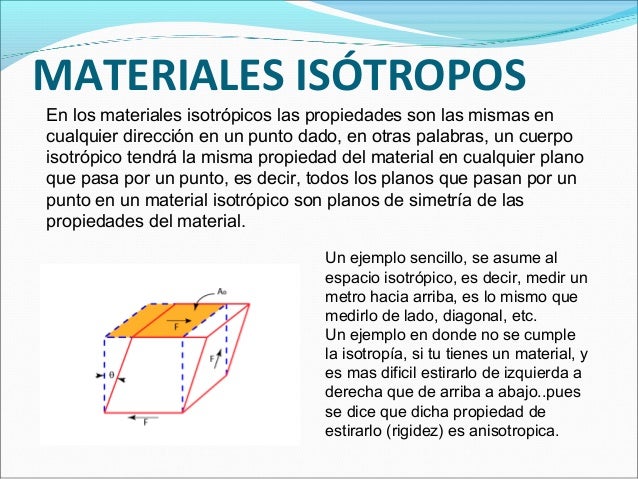
Said of a substance or body: Possessing the same properties in all directions. Isotropy is the characteristic of some phenomena in space whose properties do not depend on the direction in which they are examined. That is, it refers to the fact that certain commensurable vector magnitudes give identical or similar results regardless of the direction chosen for such measurement. When a given quantity does not exhibit isotropy, it is said to exhibit anisotropy.
Example: However, this study assumes the skin as an ISOTROPIC elastic membrane, as opposed to the Philips research laboratory study 15 of a multi-layered non-ISOTROPIC material.
en: isotrópico
Thermal analysis
adjective
Thermal analysis is a branch of materials science where the properties of materials are studied as they change with temperature. Several methods are commonly used, which are distinguished from each other by the property being measured
Example: Simultaneous THERMAL ANALYSIS (STA) was performed on samples x =30 to x =40 to determine their glass transition temperature (T g ) which reduces their compositional uncertainty